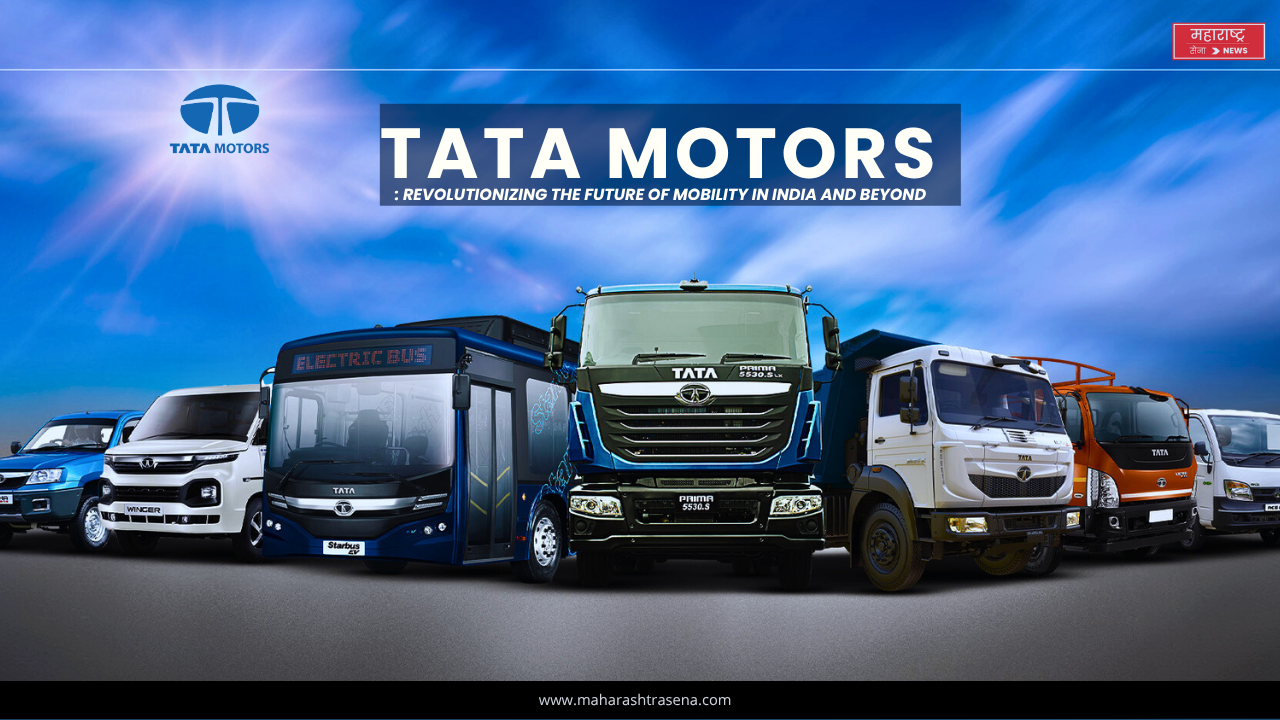
Tata Motors: Revolutionizing the Future of Mobility in India and Beyond
Introduction
Tata Motors Limited, a flagship company of the Tata Group, is one of India’s largest automobile manufacturers. Founded in 1945, the company has played a crucial role in shaping India’s automotive landscape. From manufacturing commercial trucks to pioneering electric vehicles (EVs), Tata Motors has become a global symbol of innovation, reliability, and sustainable mobility.
Tata Motors is an Indian multinational automotive company. and its headquartered in Mumbai and part of the Tata Group. The company produces cars, trucks, vans, and buses.
The Tata Motors company’s notable subsidiaries include Jaguar Land Rover, Tata Daewoo and Iveco .
Joint ventures– Tata Motors company has joint ventures with Hitachi (Tata Hitachi Construction Machinery) and Stellantis, which makes engines & vehicle components for Fiat Chrysler & Tata-branded vehicles.
Auto Manufacturing and Vehicle plants – Tata Motors has auto manufacturing and vehicle plants in Pune, Jamshedpur, Lucknow, Sanand, Pantnagar, and Dharwad in India, as well as in other country like- Argentina, the United Kingdom, South Africa, and Thailand.
Research and Development Centers – Tata Motors has research and development centers in Pune, Lucknow, Dharwad, Jamshedpur, India and other countries like the United Kingdom, South Korea, and Spain.
Company Rank – Tata Motors company is ranked 283rd on the Fortune Global 500 list of the world’s biggest corporations as of 2024.
Tata Motors is listed on the BSE & NSE, and is a constituent of the BSE SENSEX & NIFTY 50 benchmark indices.
With the brand promise “Connecting Aspirations”, Tata Motors continues to lead India’s transition towards modern and environmentally responsible transportation.
Tata Motors Passenger Vehicles Ltd
| Formerly | Tata Engineering and Locomotive Company Ltd. (TELCO) |
| Company Type | Public |
| Traded as | BSE: 500570, NSE: TATAMOTORS, BSE SENSEX constituent, NSE NIFTY 50 constituent |
| ISIN | IN9155A01020 |
| Industry | Automotive |
| Founded | 1945; (80 years ago) |
| Founder | J. R. D. Tata |
| Headquarters | Mumbai, Maharashtra, India |
| Area served | Worldwide |
| Key people | Natarajan Chandrasekaran (chairman), PB Balaji (CFO) |
| Products | Automobiles, Luxury vehicles, Commercial vehicles, Automotive parts, Bus, trucks, SUVs, Van, Pickup |
| Production output | 1.1 million (2021) |
| Services | Vehicle service, Vehicle leasing |
| Number of employees | 91,811 (FY2024) |
| Parent | Tata Group |
Subsidiaries | Jaguar Land Rover, Iveco, Tata Motors Cars,Tata Marcopolo, Tata Daewoo, Tata Technologies, Tata Hitachi Construction Machinery |
| Website | tatamotors.com |
History and Legacy of Tata Motors
Tata Motors began its journey in 1945 as Tata Engineering and Locomotive Company (TELCO). Initially, it manufactured locomotives and industrial equipment. In 1954, Tata Motors entered the automobile industry by producing its first commercial vehicle in collaboration with Daimler-Benz.
Over the years, the company expanded its operations across multiple segments, including commercial vehicles, passenger cars, SUVs, and electric vehicles. The company officially changed its name to Tata Motors Limited in 2003, symbolizing a new era of growth and innovation.
Today, Tata Motors operates in over 125 countries and owns iconic global brands such as Jaguar and Land Rover (JLR), acquired from Ford Motor Company in 2008.
Business Divisions of Tata Motors
Tata Motors’ business model is diversified into several verticals to cater to different market segments:
1. Commercial Vehicles (CV)
Tata Motors is India’s undisputed leader in the commercial vehicle segment. It manufactures trucks, buses, and construction vehicles that power India’s logistics and public transportation systems.
- Key Models: Tata Ace, Tata 407, Tata Prima, Tata Ultra.
- Market Share: Over 45% of India’s CV market.
2. Passenger Vehicles (PV)
In the passenger vehicle segment, Tata Motors has redefined safety and design standards. With 5-star safety ratings from Global NCAP, Tata cars are known for their build quality and affordability.
- Popular Models: Tata Nexon, Tata Punch, Tata Safari, Tata Harrier, Tata Tiago.
3. Electric Vehicles (EV)
Tata Motors is the market leader in India’s EV segment, with over 80% market share. The company’s Ziptron technology ensures long range, safety, and affordability.
- Popular EVs: Nexon EV, Tiago EV, Tigor EV, Punch EV.
- Future Plan: Launch of EV-only platforms and battery manufacturing units.
4. Jaguar Land Rover (JLR)
JLR is Tata Motors’ luxury vehicle arm, headquartered in the UK. The acquisition transformed Tata Motors into a global player. JLR contributes significantly to Tata Motors’ international revenue.
- Brands: Jaguar (luxury sedans and sports cars), Land Rover (premium SUVs).
Innovation and Research
Tata Motors invests heavily in research and development (R&D) to stay ahead of the curve. The company operates R&D centers in India, the UK, Italy, and South Korea.
Focus areas include:
- Electric and hybrid powertrains
- Autonomous and connected vehicle technology
- Lightweight materials for improved fuel efficiency
- Smart mobility and digital integration
Tata Motors Financial Performance and Stock Analysis
As of FY2024-25, Tata Motors reported revenue of approximately ₹4.39 lakh crore, with consistent growth driven by domestic sales and JLR performance.
- Tata Motors Share Price: A major attraction for investors, the stock has shown steady growth over the last few years.
- Dividend: The company declared a ₹6 per share dividend in FY2025.
- Profit Trends: Despite occasional market slowdowns, the company’s long-term outlook remains positive.
Sustainability and Corporate Social Responsibility (CSR)
Sustainability is at the heart of Tata Motors’ operations. The company actively focuses on:
- Reducing carbon emissions and adopting green manufacturing.
- Developing affordable EVs for the Indian middle class.
- CSR initiatives in education, skill development, healthcare, and environmental conservation.
Challenges and Future Outlook
Despite strong growth, Tata Motors faces several challenges:
- Rising competition in the EV space from brands like Mahindra, Hyundai, and Tesla (in the future).
- Fluctuating raw material costs and chip shortages.
- Global economic uncertainties affecting JLR sales.
However, the company’s vision 2030 includes:
- 100% electrification of its passenger fleet.
- Expanding exports to new markets in Africa and Southeast Asia.
- Enhancing digital and AI-driven customer experience.
Products
Land Rover and Jaguar

Current Jaguar products
- Jaguar F-Pace (compact luxury SUV) – (Production Feb 2016–present)
Former Jaguar products
- Jaguar XE (compact executive car) – (Production
Apr 2015–2024) - Jaguar XF (executive saloon & estate) -(Production
2015–2024) - Jaguar F-Type (sports car – coupé and convertible) – (Production
2013–2024) - Jaguar E-Pace (high end subcompact luxury SUV) – (Production
2017–2024) - Jaguar I-Pace (compact luxury electric SUV)- (Production
2018–2024)
Current Land Rover products
- Discovery (mid-size luxury SUV)
- Discovery Sport (subcompact luxury SUV)
- Defender (off-road luxury 4×4)
- Range Rover (full-size luxury SUV)
- Range Rover Sport (mid-size luxury SUV)
- Range Rover Velar (high end compact luxury SUV)
- Range Rover Evoque (high end subcompact luxury SUV)
Passenger vehicles
Current Models
| Model | Year of Introduction |
|---|---|
| Hatchback | |
| Tata Tiago | 2016 |
| Tata Altroz | 2020 |
| Sedan | |
| Tata Tigor | 2016 |
| SUV/Crossover | |
| Tata Punch | 2021 |
| Tata Nexon | 2017 |
| Tata Curvv | 2024 |
| Tata Harrier | 2018 |
| Tata Safari | 2021 |
| Tata Sierra | 1991 |
| Electric | |
| Tata Nexon EV | 2020 |
| Tata Tigor EV | 2021 |
| Tata Tiago EV | 2022 |
| Tata Punch EV | 2024 |
| Tata Curvv EV | 2024 |
| Tata Harrier EV | 2025 |
Commercial vehicles
- Tata Ace
- Tata Ace Zip
- Tata Ace EV
- Tata Super Ace
- Tata Ace Mega
- Tata Intra
- Tata Intra V10
- Tata Intra V20
- Tata Intra V30
- Tata Intra V50
- Tata Xenon XT
- Tata Yodha
- Tata Iris
- Tata TL/Telcoline/207 Pick-up truck
- Tata 407 Ex and Ex2
- Tata 709 Ex
- Tata 807 (Steel cabin chassis, cowl chassis, medium bus chassis, steel cabin + steel body chassis)
- Tata 809 Ex and Ex2
- Tata 909 Ex and Ex2
- Tata 1210 SE and SFC (Semi Forward)
- Tata 1210 LP (Long Plate)
- Tata 1109 (Intermediate truck/ LCV bus)
- Tata 1512c (Medium bus chassis)
- Tata 1515c/1615 (Medium bus chassis)
- Tata 1612c/1616c/1618c (Heavy bus chassis)
- Tata 1618 (Semilow-floor bus chassis)
- Tata 1623 (Rear-engined low-floor bus chassis)
- Tata 1518C (Medium truck) 10 ton
- Tata 1613/1615c (Medium truck)
- Tata 1616/1618c (Heavy duty truck)
- Tata 2515c/2516c/2518c (Heavy duty 10-wheeler truck)
- Tata Starbus (Branded buses for city, intercity, school bus, and standard passenger transportation)
- Tata Divo (Hispano Divo)
- Tata CityRide (12- to 20-seater buses for intracity use)
- Tata 3015 (Heavy truck)
- Tata 3118 (Heavy truck) (8×2)
- Tata 3516 (Heavy truck)
- Tata 4018 (Heavy truck)
- Tata 4923 (Ultraheavy truck) (6×4)
- Tata Novus
- Tata Prima
- Tata SIGNA series
- Tata Ultra series (ICV Segment)
- Tata Winger – (Maxivan)
Electric vehicles
List of Tata electric vehicles:
- Tata Curvv EV
- Tata Nexon EV
- Tata Tigor EV
- Tata Tiago EV
- Tata Punch EV
- Tata Harrier EV
Electric Vehicle Concepts
- Tata Avinya
- Tata EVision
- Sierra.ev
Discontinued Models
- Tata Telcoline (1988–2010)
- Tata Sierra (1991–2003)
- Tata Estate (1992–2000)
- Tata Sumo (1994–2019)
- Tata Indica (1998–2015)
- Tata Spacio (2000-2011)
- Tata Indigo (2002–2015)
- Tata Indigo Marina (2006–2009)
- Tata Xenon (2007–2018)
- Tata Sumo Grande (2008–2016)
- Tata Vista (2008–2015)
- Tata Nano (2008–2018)
- Tata Manza (2011–2016)
- Tata Venture (2010–2017)
- Tata Aria (2010–2017)
- Tata Zest (2014–2020)
- Tata Bolt (2014–2019)
- Tata Hexa (2017–2020)
Why Tata Motors Is the Best Car Company in India
Tata Motors’ success lies in its ability to combine affordability, safety, and innovation. Unlike competitors, Tata cars offer:
- 5-star safety ratings (best in India).
- Stylish design with premium features.
- Strong resale value and service network.
Conclusion
Tata Motors stands as a true example of India’s industrial power and technological advancement. From manufacturing trucks for Indian roads to exporting luxury cars worldwide, Tata Motors has redefined what it means to be a global Indian brand.
With its commitment to sustainability, leadership in electric mobility, and customer-centric approach, Tata Motors is not just building cars — it’s shaping the future of mobility.
In short: Tata Motors is driving India toward a cleaner, smarter, and more connected future.
tata motors jaguar, tata motors cars, Tata Motors, tata motors commercial vehicles, tata motors showroom mumbai, tata motors bike, tata motors showroom near me, tata motorcycle, tata motors 2 wheeler, tata motors passenger vehicles,
Tata Motors share price, Tata Motors EV, Tata Motors stock analysis, Tata Motors future plans, Tata Motors electric vehicles, Tata Group companies, best car company in India, Tata Motors market share, Tata Motors dividend, Tata Motors sustainability, Tata Motors growth strategy,
Tata Motors commercial vehicle price, Tata truck business, Tata bus price in India,
Best SUV in India, Tata Nexon EV price, Tata Punch mileage, Tata Harrier review,
Tata Motors EV price, Tata Nexon EV Max range, Tata Tiago EV features, Tata Motors electric vehicle stock,
Jaguar Land Rover stock, Tata Motors JLR revenue, Tata Motors global presence,
Tata Motors R&D, Tata Motors innovation, Tata Motors technology, Tata Motors AI in cars,
Tata Motors share price today, Tata Motors stock forecast, Tata Motors dividend 2025, Tata Motors Q4 results,
Tata Motors sustainability, Tata Motors CSR, Tata Motors green initiative, Tata Motors renewable energy,
Tata Motors future plans, Tata Motors 2030 vision, Tata Motors EV future, Tata Motors growth strategy,
Best car company in India, safest cars in India, Tata Motors vs Mahindra, Tata Motors customer reviews
1 thought on “Tata Motors”
Comments are closed.